
 |
 |


|
|
|
|
|
| ||||||||||||||||||||
|
| |||||||||||||||||||||
|
| |||||||||||||||||||||
| |||||
|
|
|
One machine can do the work of fifty ordinary men. No machine can do the work of one extraordinary man. -- Elbert Hubbard |

How many ops does it take to run a world class 160 multi-op station? At W2GD, it takes 3: (Left to Right) K2SG operates the "multiplier" position while W2NO and K2TW pilot the "run" position. |
As every avid contester knows, each HF band has a personality. Depending on the time of day, one band is better suited than another for any one of a number of reasons. "Topband" (a.k.a. 160-Meters) has a reputation too -- a reputation rooted in tradition, folk-lore, and pure science. Old timers call it the gentleman's band--and for good reason. It takes a plantation sized estate to support a world class antenna. It is also very fragile. Since the whole continent is open to propagation, participants must cooperate in a gentlemanly fashion and deal with QRM and QRN from just about everywhere. Learning Topband traditions takes time and practice. You may likely be called a LID a time or two until you figure it all out (an Elmer really helps). Doing well in the 160 requires skill, finesse, and yes, lots of big hardware.
Those who have come to love Topband wouldn't miss the ARRL 160M Contest. The folk-lore that says you need a 160 Acre estate to 'compete' is simply not factual. This year, 58 new "Section Records" were set. In the Regional competition, 8 new records summarily forced old records kicking and screaming into the archives. Some of these new records were set by people using considerably less than 'world class' systems.
| What counts is not necessarily the size of the dog in the fight --
it's the size of the fight in the dog. |
Although the 857 logs submitted indicates a decline from 2002's record shattering year with 919 logs, the trend is still up (2001 had 777 logs). K9DX landed the highest Q count of 1498, which is down from 2002's maximum of 1592 by VY2ZM. With the sun spot doldrums lurking around the corner, you can expect a large increase in 2004's running of the 160M contest. Higher top score records requires more Qs from more participants. As the sun spot minimum approaches, 160M propagation should be at a peak. Let's hope the contest community responds to this 11 year anomaly by having more people show up to compete for top honors. With summer here, I encourage everyone, especially the clubs, to start Elmering new ops by helping them get their 160M station running.
This year's summary tables include a new twist. (s) Appears next to the call
sign of the op that challenged and retired a "Section" record during this year's
contest. (r) Appears if the score represents a new "Region" record. The analysis
goes back to and includes 1997. I am excited about this new feature. For the
first time, ops in every section can examine the top scores of record for their
Section or Region and challenge the previous "bests." If you 'own' a Section or
Region record that is older than 1997 that tops these, let me offer my
apologies. Notify the contest desk at the ARRL and your achievement will be duly
noted in future presentations of this table and on the web. The web contains
updated information on the individual Sections and Regions. You can look at your
2003 performance and compare it to the top scores of prior years. I encourage
holders of older records to examine the history for your Section and claim what
is rightfully yours. Just reference the appropriate QST date and page in your
claim.

Don, KB2EBL, demonstrates his patience -- a key tool for operating on Top Band. |
While there were no Top Ten records broken in 2003, there were several spectacular performances given this year's somewhat unsettled propagation conditions. N8VW tops the Single Op QRP category, leaving 5 record breaking scores from 1997 and 1998 intact. K2BA missed landing the all-time high score in the Single Op Low Power category, leaving W3GH's 2001 effort as the high score on record. AA1K took a commanding lead over K9DX for the #1 spot in Single Op High Power category, but left K1ZM's spectacular performances from VY2ZM in both 2001 and 2002 untarnished. And finally, W2GD took top honors in the Multi Op category, leaving KC1XX's 2002 score the current top Multi score on record. It is interesting to note that two High Power Single Ops, AA1K and K9DX, both managed to edge out the all the Multi-op stations this year.
The regional competition analysis attempts to level the playing field somewhat. Everybody knows the Northeast enjoys the clearest path to EU and dozens of 'extra' DX mults. Parsing the scores by region, exemplary performances are observed when factoring in the geographic handicaps. Summarizing 1997 through 2003 by adding the top five scores for each competition class for each year, for each Region, we find the interesting results shown in Chart 1.
| ||||||||||||||||||||||||
It is safe to conclude that the Northeast and the Central regions have slightly better propagation to population centers and DX multipliers than the rest. The Southeast and Midwest regions are roughly comparable in this regard. The West Coast is clearly handicapped. Considering this table summarizes each region's 5 best ops for each category for 7 years. This table serves to illustrate the effects of regional differences.
As mentioned earlier, 8 Regional records were retired this year: Central and West Coast Regions had 3 new records, with Midwest changing 2 more.
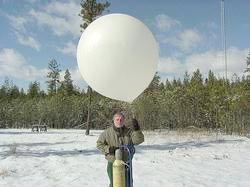
Gary, K7OX, launched and used a 1/4 full size vertical balloon the first night. However, bad weather (i.e., very high winds and rain/snow) caused him to loose the balloon around 6AM local time Saturday morning. The second night it was still very windy so he finished out the contest using his back up antenna (a shunt fed tower which seemed to work OK.) |
Among the QRP contestants, N7IR managed to retire his old West Coast record(s) by quite a margin. N8VW retires N9JF's 1997 QRP record in the Midwest Region. The only Low Power Op to land a Regional record was K2BA in the Midwest competition, effectively ending K7CA's 3 consecutive year rally. K9DX was able to significantly improve on his 2002 SOHP top score in the Midwest Region. The Multioperators were able to land new records in several regions. K8XXX placed a tombstone on WB9Z's 1997 Multiop record in Central. N0NI improved their now 5 out of 7 year top score in the Midwest. N7GP has a West Coast record score for the 2nd year running.
Almost half of this year's participants submitted a score crediting their local club. Although the 421 logs submitted by club members dropped slightly from 2002's record breaking 464, the competition for top scores was fierce. Moving to the Unlimited Category for the first time is the Minnesota Wireless Association. A three year long campaign to get people into the 160M contest appears to be working. The MWA reported 24 logs in 2001, 47 logs in 2002, and 52 logs for 2003, a steady increase in participation. Whereas SMC reported 77 logs for 2001, 67 logs in 2002, and 52 logs in 2003, a steady decrease in participation. Let's hope SMC can reverse the trend.
It is interesting to note that this year's Top Scoring Medium category club, the Potomac Valley Radio Club, would have posted top honors in the Unlimited category if they had submitted 3 more logs with at least 1 Q. This allows SMC to enjoy yet another year of top billing in the Unlimited category. Congratulations to SMC.
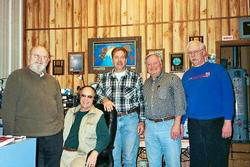
The AK9F Multi-S group celebrates another successful ARRL 160 Meter Contest operating from the great station of WB9Z. From left to right: Will K9FO, Howard AK9F, Jerry WB9Z, Don K9NR and Carl K9CS. This group has been teamed on 160 meters for over 20 years and consistently places in the top ten. |
3 clubs appear on this year's Medium category list for the first time. The Carolina DX Assn grabbed the 18th position on the list. The Northern Arizona DX Assn must be enthusiastic about 160M because Arizona is one section that had new Section records set in all entry classes. The Mother Lode DX/Contest Club gets the rookie club of the year award for landing the 28th slot on this year's list. Hey! Somebody had to grab that spot!
This year's running of the ARRL 160M Contest promises to be the start of a new wave of record breaking scores. After looking at the details of this year's upsets, I suspect there will be a few 'grudge' matches on Topband in 2004. The 'gloves' are coming off this year! A Topband 'death match!' I can't wait. While the lack of speckles on the sun is wreaking havoc on the higher bands, conditions are moving towards the peak of 160M propagation (sun spot minimum). The companion web article will have lots of good information about contest records. In particular, the new "Section" and "Region" history will enable participants to check their performance on the local level for the first time. I'm sure there are many stations eager to place their call high enough on the list to survive several sun spot cycles! See you the first weekend in December.


